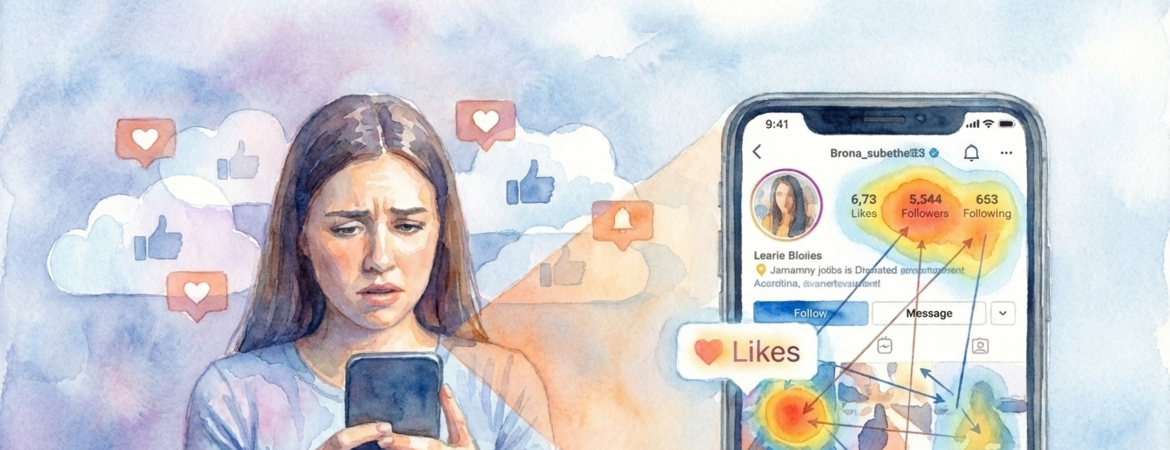
Social media has become a huge part of everyday life for many people, but its constant stream of comparison and evaluation can take a toll on users’ mental health. This study examined how anxious youth pay attention to social media cues, such as likes and posts, to better understand if these platforms can heighten anxiety and how better designs might ease that stress. Instagram, one of the most popular platforms among young people, amplifies social pressures through its focus on photos, likes, and follower counts. This often pushes users—especially young women—to compare themselves to idealized images and to develop insecurities about their appearance or popularity. These metrics act like public scoreboards, making popularity easy to see and compare. Many young people interpret these numbers as judgments of their social worth.
Background
Attentional bias is the tendency to pay special attention to things considered “socially threatening,” such as someone getting upset. For anxious individuals already more sensitive to rejection and status, these cues can feel especially threatening, leading to negative comparisons and a heightened sense of social pressure online. These individuals also might find it difficult to shift their focus away from the threat afterwards.
One frequently used tool to measure attentional biases is eye-tracking. Eye-tracking measures when and for how long an individual attends to visual stimuli. In this study, McGowan and colleagues used eye tracking to measure visual interactions by young women experiencing anxiety symptoms with specific sections of a screen or areas of interest (AOI; e.g., follower count of a profile).
Methods
The study participants included a total of 69 young women between the ages of 18 and 24 who identified as shy or anxious, with normal or corrected-to-normal vision. Participants completed an online survey that contained questions relating to their background and anxiety symptoms. Next, participants completed an in-person eye-tracking task. The eye-tracking task showed an Instagram profile created by the researchers for five seconds, allowing participants to view it as they would on their own device. Participants viewed a total of 24 different profiles, with half the profiles having a high follower count and the other half having a low follower count. Researchers measured attentional bias across three metrics:
- First fixation latency, or how quickly it takes for someone to look at an AOI
- Total dwell time, or how long they spend looking within an AOI
- Fixation count, or the number of times they look at an AOI
Findings
This study was guided by two hypotheses. The first stated that those who are more anxious will quickly identify the follower count and number of likes in a profile, and then start avoiding those areas. The second stated that overall, youth will quickly find and look longer at high-popularity profiles compared to low-popularity profiles. In contrast, researchers expected highly anxious youth to avoid high-popularity profiles, instead of dwelling on them.
Inconsistent with the proposed first hypothesis, results indicated that first fixation latency was shorter for the overall profile than for the follower count and likes, meaning participants took longer to direct their eyes to the follower count and likes. However, in support of the hypothesis, they tended to avoid looking at those areas. Participants reporting increasing anxiety symptoms spent less time fixating on follower count/likes, and made fewer fixations in general.
Similarly, results were inconsistent with the second study hypothesis. The authors reported that the duration of fixation did not differ for profiles with high and low follower counts. However, participants fixated more on profiles with higher like counts than on profiles with lower like counts.
Conclusion
The purpose of this study was to understand how anxious youths interact with social media and what features of these platforms might heighten their anxiety. The researchers examined attentional bias and anxiety by examining eye-tracking data collected as participants viewed Instagram profiles with varying amounts of likes and follower counts. The results of this study found that higher anxiety symptoms were linked to consistent avoidance of socially evaluative cues (likes and follower counts), suggesting participants viewed them as socially threatening cues. It was also noted that anxious participants avoided evaluative cues regardless of profile popularity, suggesting that internal anxiety, not popularity, drove attention patterns.
This student has several limitations, including limited platforms, artificial stimuli, forced interactions, (use of posts that were artificially created, which can create a lack of natural interaction), no direct measures of social comparison, a sample of only female subjects, and limited data on participants' social media use. Despite this, these findings contribute meaningfully to work examining social media engagement. Ultimately, the results suggest that anxiety shapes how individuals process social evaluation signals on social media. This study improves our understanding of the patterns observed, which may help in the development of better prevention and intervention strategies for anxious youth.
Full article: https://www.sciencedirect.com/science/article/pii/S0010440X25000690