
Why should I teach my own R'Course?
Creating and teaching your own R’Course is easier than you think, and we’ll help you every step of the way
Some benefits to teaching a R'Course are:
- Develop your public speaking and leadership skills.
- Distinguish yourself on your resume and during interviews (employers want to hear how an undergraduate was able to teach a college class!).
- If you want to go to graduate or professional school, teaching a R'Course can help you get funding to become a graduate assistant!
- If you want to be a teacher, this is GREAT opportunity to design and teach your own course from beginning to end.
- The skills you learn teaching a R'Course are transferrable to any industry and will help you build leadership skills, communication skills, teamwork skills, technology/research skills, and equity and inclusion skills. These are ALL skills that employers are looking for in students, and are also part of our EXCEL+ Career Readiness plus Leadership program (excel.ucr.edu)
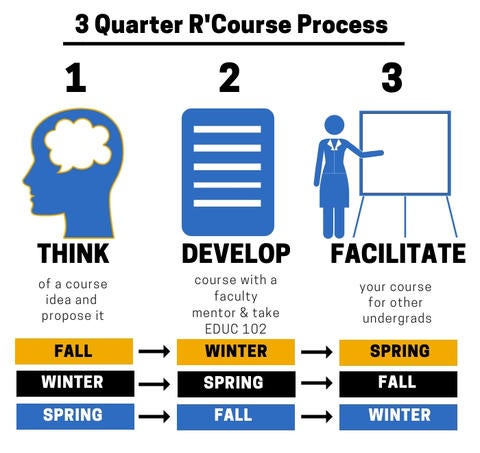
The process is conducted in three phases: Think/Apply, Develop/Learn, and Facilitate.
- The Think/Apply phase (Quarter 1) requires students to think of a course topic, identify a faculty mentor, develop the idea, and submit a proposal.
- The Develop/Learn phase (Quarter 2) requires future facilitators to enroll in 1-unit of independent study with their faculty mentor to develop the course content and to enroll in 1-unit of UGRC 1B to learn about course facilitation.
- In the Facilitate phase (Quarter 3), students lead the course for their peers.
Proposal Deadlines:
| Quarter | Deadlines |
|---|---|
| Fall | Oct. 20 |
| Winter | Jan. 20 |
| Spring | Apr. 20 |
Needed to complete form:
Student Facilitator(s) Information
Faculty Mentor name and email
Department Chair name and email
Draft syllabus (USE Template!)
Resume or C.V.
Create a Course
Please read through all of the information on how to create a course before you turn in a proposal. If you need assistance, email us at rcourses@ucr.edu.
-
Requirements
Requirements for R'Course Facilitators:
- Current UCR undergraduate student.
- 3 quarters remaining at UCR. You cannot teach an R'Course after you have graduated
- GPA = 2.5 or higher (email us if you are a new transfer student)
- A UCR faculty member has agreed to mentor your course.
- Make sure your faculty mentor is Academic Senate Faculty (tenure track, Assistant Professor, Professor, Associate Professor). Adjunct or part-time instructors may mentor you unofficially, but you must still have an Academic Senate Faculty member as your official mentor. Contact us at rcourses@ucr.edu with any questions about this requirement
Tips for Finding a Faculty Mentor
- Start with faculty you have a relationship with.
- Reach out to faculty who have a background in your course topic.
- Use our list of previous faculty mentors for faculty who have mentored an R'Course
-
Student Facilitator Process
Step 1 –
Think of a unique topic that you would like to share with your peers!
- Make sure you check the UCR Course Catalog and past R’Course offerings to ensure that your topic is original and hasn’t been taught before. Part of the process is for you to develop your own original content for the course.
Find a faculty mentor who can support you in the development of the course, by reviewing your topic and course objectives.
Work with your mentor to create a proposal. A completed proposal includes:
- Online R'Course Proposal Form
- When you fill out the form, automatic emails will be sent to your faculty mentor and department chair for their approval.
- Completed draft syllabus of your proposed course.
- Use our Syllabus template!
- Resume or Curriculum Vitae
Submit your proposal by the deadline listed below, but earlier is better! R'Course staff will contact you if your proposal needs revisions before going to the R'Course Governing Board for approval or denial.
List of all R'Course Faculty Mentors
Proposal process timeline Quarter Proposal Deadline
EDUC 198 & XXX 190 Teach Fall October 20 Winter Spring Winter January 20 Spring Fall Spring April 20 Fall Winter Step 2 -
Once your proposal has been accepted, you will enroll in 2 classes during the 2nd quarter:
- 1 unit of independent or directed study with your faculty mentor.
- Work on developing your syllabus further, including your reading, class resources, and potential guest speakers or outside classroom activities.
- UGRC 198 - Democratic Pedagogy: Developing R'Courses (1-unit). This course will help you:
- Gain important knowledge about democratic education,
- Enable you to further expand your syllabus and class coursework,
- Practice facilitation techniques in a learning environment,
- Help you develop a supportive network for your teaching experience.
Step 3 -
Time to teach!
-
R’Courses Forms and Information Guides
- Faculty Guide (Helpful to give to a potential faculty mentor)
- Department Chair Guide
- Online R'Course Proposal Form
- Student Guide (Useful checklist)
- Syllabus Template
- UCR Catalog (check for similar courses)
- Previous R'Courses (check for similar courses)
-
Faculty Mentor Expectations
Quarter 1
- Student applicants must identify a faculty mentor who will assist them with developing the course.
- Review student facilitator(s) syllabus and proposal form and make suggestions for revisions or additions.
- Once the student submits their proposal, sign the online faculty proposal form
- Meet (in person or via phone/email) with student(s) to outline expectations for the 2nd quarter for the 1 unity independent or directed study course (XXXX 190) in your department.
Quarter 2
- The student will register for 1 unit of Independent or Directed Study (190) credit with the faculty mentor after the proposal has been accepted by the R’Course Governing Board This preparation course will consist of assignments/research as needed to continue developing the course content.
- Assist the student in creating classroom assignments, resource/reading lists, guest speakers, etc. for the R'Course.
- Assign a grade to the facilitator(s) for work completed in the 190 course.
- Ensure that the R'course meets all university policies that apply to courses for unit credit at UCR, paying particular attention to course content, appropriate workload for a 1-unit course, instructional standards, and academic integrity.
- The student will also take UGRC 198: Democratic Pedagogy (1 unit) with R'Course staff. This course will cover:
- Developing and revising course materials (syllabus, assignments, etc.)
- Principles of Democratic Education
- Bloom's Taxonomy
- Classroom discussion strategies
- Using technology to enhance student engagement
- Lesson Planning
- Library and other campus resources
- Canvas and other campus technologies
Quarter 3
- Meet (in person or via phone/email) with the student(s) periodically during the quarter to discuss the progress of the course.
- Attend at least one class session (but no more than three) and provide the student with helpful constructive feedback.
Faculty Resources
-
Additional Resources
Student-led courses at other institutions (many of these are student websites)
- UTeach - UC Irvine
- DeCal (Democratic Education at Cal) - UC Berkeley
- Undergraduate Student Initiated Education - UCLA
- Education for Sustainable Living Program - UC Santa Cruz
- Student Taught Courses - Rice University
- StuCo (Student College) - Carnegie Mellon University
- ExCo (Experiemental College) - Oberlin College
Working with a Faculty Mentor:
- How to Find a Faculty Sponsor (UC Berkeley - DeCal)
Syllabus:
- Preparing a Syllabus (The Teaching Center - Washington University in St. Louis)
- Syllabus Components (Mellon Faculty Institute on Undergraduate Research - UC Berkeley)
- Syllabus Checklist (Center for Educational Effectiveness, University of Delaware)
Teaching:
- Asking Questions to Improve Learning (The Teaching Center - Washington University in St. Louis)
- Increasing Student Participation (The Teaching Center - Washington University in St. Louis)
- Teaching with Lectures (The Teaching Center - Washington University in St. Louis)
- Tips for Faculty Teaching for the First Time (The Teaching Center - Washington University in St. Louis)
- Using Class Time Effectively on Day One (The Teaching Center - Washington University in St. Louis)